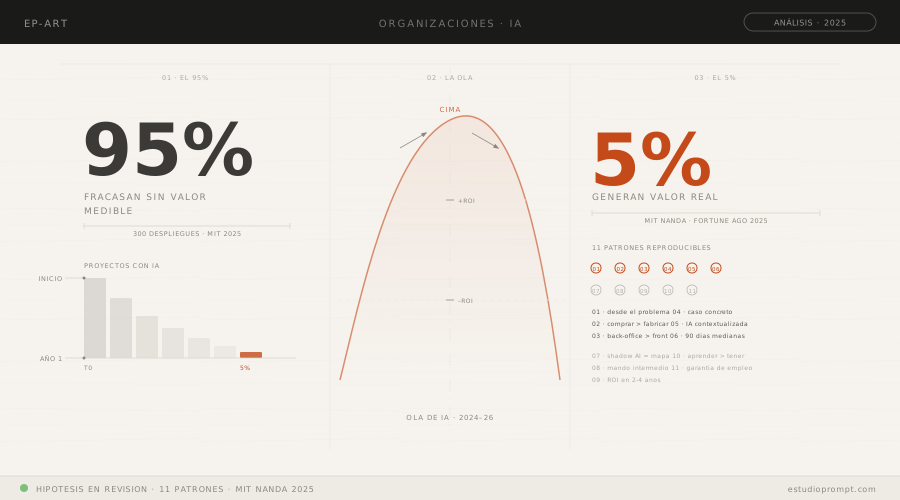
Looking for reproducible patterns in the success stories.
Versión en español: Organizaciones que surfean la ola de la Inteligencia Artificial ↗
The starting point
AI adoption is massive. Value is rare. 88% of organizations already use AI in at least one function, but only 39% report any impact on their bottom line — and most attribute less than 5% of EBIT to it. Barely ~6% qualify as high performers: organizations capturing significant value. That is McKinsey’s conclusion after surveying nearly 2,000 organizations across 105 countries.
McKinsey — The State of AI 2025 ↗
The most cited study — and also the most disputed — points in the same direction. MIT analyzed 300 real deployments, conducted 150 interviews with leaders and surveyed 350 employees. The conclusion, published in The GenAI Divide: State of AI in Business 2025: the vast majority of generative AI pilots stall, with no observable impact on the P&L.
“Just 5% of integrated AI pilots are extracting millions in value, while the vast majority remain stuck with no measurable P&L impact.” — MIT NANDA, The GenAI Divide: State of AI in Business 2025
MIT NANDA — Fortune, August 2025 ↗
(The MIT report drew methodological criticism after publication. At the end of this article you’ll find what the critics say — and why the analysis still stands.)
The third leg comes from BCG, which measured adoption in the workplace and found the silent variable: in the companies furthest along with AI, 46% of employees fear for their jobs — and visible leadership support raises the share of employees positive about generative AI from 15% to 55%.
Three independent studies, one picture: almost every organization already uses AI; only 5 or 6 out of 100 capture real value. In this article we’ll call that minority “the 5%”. And within that 5%, there is a pattern.
The dominant pattern
Successful projects share a trait that rarely shows up in budgets or strategic plans: the solutions were proposed by employees. They didn’t come down from management. They emerged from the people who know the processes, spot the frictions, and know where a well-applied AI actually changes something.
Research on organizational innovation confirms it: the ideas that emerge from within are the ones that last. The MIT report itself states it without ambiguity: transformation works when line managers and operations teams are empowered, not when everything is concentrated in central AI labs.
London Business School — Employee-led innovation ↗
But this pattern — the bottom-up direction of flow — is not the only one. When you cross-reference the MIT report, Andreessen Horowitz’s data on real adoption in the Fortune 500, the analyses from Deloitte and Google Cloud, and the field studies on shadow AI published by IBM and Microsoft, a list of repeated patterns emerges. They are not hypotheses. They are the observable characteristics of the organizations that are actually riding the wave.
The patterns of the 5%
1. Good ideas are born where the problem lives, not where the budget lives
Employees who run a process know where it hurts. Executives know what they want to achieve. When the idea for applying AI is born in the person who executes — not the person who budgets — the solution fits the real workflow. When it’s born the other way around, you build a system nobody asked for to solve a problem only visible from above.
“Leadership sees inefficiencies in aggregate; employees experience them in detail.” — Xponent21, Rethinking AI Adoption
Xponent21 — Bottom-Up AI Adoption ↗
2. Buying what already exists works better than building in-house
The data is blunt: buying tools from specialized vendors and building partnerships with them succeeds in around 67% of cases. Building internally succeeds only a third as often. The “we’ll build it ourselves” instinct is paid for dearly, especially in regulated sectors where the reflex runs the other way.
Fortune — MIT Report on AI Pilots ↗
Many companies believe they need to build their own “custom” AI from scratch. The statistics say the opposite: buying a tool that already exists and adapting it works twice as often as trying to build your own.
3. AI where nobody sees it pays more than AI in the spotlight
More than half of generative AI budgets go to sales and marketing. The highest ROI, however, sits in back-office automation: eliminating BPO, cutting external agency costs, streamlining operations. There is a persistent bias toward the visible, and a persistent return in the invisible.
UC Berkeley — Beyond ROI in AI Success ↗
Companies tend to invest in the AI that shines — campaigns, chatbots, flashy commercial tools — but the money comes back through the boring side: processing invoices, classifying emails, organizing data. The tasks nobody sees are usually the ones that cost the most and save the most.
4. Solving a concrete problem beats “transforming the organization”
Projects that work target a specific, measurable, recent pain. Projects that fail tend to start with phrases like “transforming the organization” or “enabling AI capabilities across the company”. Mega-strategies generate slide decks; micro-strategies generate returns.
“The most successful organizations are not just experimenting with one-off projects; they are strategically scaling AI agent deployment, focusing on high-value use cases.” — Google Cloud, The ROI of AI
Google Cloud — The ROI of AI ↗
“I’m going to apply AI so invoice approval takes half the time” is a project that works. “We’re going to transform the company with AI” is a presentation line that rarely goes anywhere.
5. An AI that knows your company outperforms a generic AI by far
ChatGPT and its peers work extraordinarily well for individuals because of their flexibility, but they stall in enterprise settings because they don’t learn or adapt to how each organization works. The 5%‘s projects incorporate memory, connection to internal systems, and the ability to adapt to specific processes. AI with organizational context performs several times better than the same AI without it.
Legal.io — MIT Report on GenAI Divide ↗
It’s the difference between asking a consultant who just arrived and one who’s been in the house for years. The same question, but answers of very different value.
6. If it takes too long to go from pilot to real use, it dies along the way
Mid-sized companies move from pilot to real use in roughly 90 days. Large enterprises take 9 months or more. Speed is not a whim: the stretch between the experiment and the final implementation is where most projects die. The longer the crossing, the more likely the death by reorganization, shifting priorities, or losing the executive who championed it.
Virtualization Review — MIT NANDA Findings ↗
If an AI pilot takes nine months to become something used in the day-to-day, odds are that by then the project won’t matter to anyone.
7. The AI your employees use in secret is not a risk — it’s a map
80% of workers use AI at work, but only 22% do so exclusively with the tools their company gave them. The rest use ChatGPT, Claude or similar on their own, without official permission. Organizations that treat that usage purely as a security risk lose the most valuable information they could get: where, exactly, their employees have already discovered that AI adds value. Every “under the radar” use is a project proposal in disguise.
If your team is using AI on their own for specific tasks, they’re telling you for free where AI works in your company. Punishing it means losing that information; listening means gaining it.
8. Middle managers decide whether AI really gets in or not
Employees learn to use tools by watching their direct bosses. If the middle manager doesn’t understand AI, doesn’t prioritize it or doesn’t use it, no central program will compensate for that absence. Success isn’t decided in the board room or at the base; it’s decided in the middle layer that translates vision into daily execution.
TechClass — Why Middle Managers Drive AI Transformation ↗
If your direct boss doesn’t use AI, neither do you. No matter what the CEO says in a presentation.
9. Expecting results in six months kills the project before it can breathe
Only 6% of implementations achieve returns in under a year. Most take between 2 and 4 years. Organizations that evaluate AI with the same templates they use for traditional IT projects discard viable initiatives before they can prove anything. How success is measured is, in many cases, the real cause of failure.
Master of Code — AI ROI in 2026 ↗
If you demand that an AI project deliver profits in six months, you’ll cancel almost every good project before it has time to work.
10. Knowing how to use AI matters more than having the best AI
Successful projects don’t differ so much in the model they use — everyone has access to the same models — as in the organization’s capacity to understand what those models can and cannot do. The gap between the 5% and the rest is, to a large extent, a learning gap.
“It’s not the quality of the AI models, but the learning gap for both tools and organizations.” — Aditya Challapally, lead author of the MIT NANDA report
Kendall AI — Lessons from MIT’s 2025 Report ↗
Every company can use the same AI. What sets them apart is how much their teams know about how to leverage it, when to trust it, and when not to.
11. Without job security, nobody proposes how to automate their own work
There is a silent but decisive pattern: employees who fear losing their jobs to AI do not propose how to apply AI to their own work. The organizations that have managed to activate collective intelligence have made it explicit — in writing, publicly — that automation will mean reassignment or role growth, not layoffs. Without that guarantee, participation becomes performative: employees contribute safe ideas, not valuable ones.
Nobody is going to explain how to make their own position disappear if they believe it will leave them without a job. Trust is the precondition for the good ideas to come out.
The hypothesis
There is a reasonable possibility that the difference between the minority that captures value and the rest is not fundamentally technical. The tools are the same, the models are the same, the budgets are often comparable.
The difference seems to lie in the direction of flow and the conditions of trust: organizations that produce value with AI listen inward before buying outward, execute short before planning long, and recognize unauthorized use as a signal of information, not an infraction. And above all, they have created the conditions for their own employees to want to propose.
If this is true, it should be possible to design an environment that reproduces those patterns deliberately. Not waiting for the organization’s culture to generate them spontaneously — something most companies never achieve — but building a device that activates them within a bounded period.
Below are the characteristics such an environment would need, derived directly from the patterns identified.
Characteristics of an environment designed to reproduce the patterns
Gathering the observed patterns into a single list, an environment intending to reproduce them should:
Last a short time. A short, defined period — on the order of 30 days — respecting the pattern of mid-sized companies, the fastest at moving from pilot to real use. Long enough to produce results, short enough that the executive backing it doesn’t lose interest.
Lean on tools that already exist. Buy what’s built instead of building from scratch. The statistics are clear: the combination of specialized platforms and external services succeeds twice as often as internal development. The organization’s effort then concentrates on context and people, not technical plumbing.
Ask employees themselves to hunt for the low-visibility tasks and processes. The biggest return is in the tasks nobody sees — administration, document management, reconciliations, internal communications — and the employees who run them are the only ones who know where the real waste is. The environment must explicitly point them there, not at the flashy stuff.
Create a safe, motivating space for proposing AI ideas. This is the central piece, and the hardest to manufacture. Safe: ideas aren’t graded like exams, mistakes aren’t punished, no status is lost for proposing something that doesn’t work. Motivating: participation is recognized, ideas are seriously debated, the organization shows it values the group’s intelligence. Without these two conditions combined, what you get is conservative ideas and low participation.
Produce solutions tailored to the organization. Not generic recipes, but proposals that fit the company’s real processes, language and constraints. This requires the AI assisting the process to know the organization’s context: process documentation, goals, priority areas.
Encourage “under the radar” AI use to come into the light. 80% of employees are already using AI on their own. The environment must offer an explicit, sanction-free channel for that usage to surface as information: which tools, for which tasks, with what results. It is the most valuable map the organization can obtain, and it rarely asks for it.
Deliberately include middle managers. Employees learn to use AI by watching their direct bosses. If the middle manager doesn’t participate, doesn’t understand or doesn’t use AI, no central program will compensate. Inclusion is not decorative: it is the lever that decides whether adoption stays in the cycle or spreads into the day-to-day.
Guarantee in writing that nobody will lose their job because of AI. No employee will explain how to automate their own work if they believe it will push them out. The signed commitment to reassignment or role growth — not layoffs — is the precondition that unlocks the valuable proposals. Without that guarantee, what you collect are decorative ideas.
A hypothesis: formats that could reproduce the patterns
The characteristics above describe a profile. The open question is which concrete format gathers them best in a real organization. Three possible proposals to explore. Each is a reasonable hypothesis derived from the observed patterns, but their validation requires empirical measurement: adoption rate, quality of generated solutions, downstream implementation rate, retention of participating staff and, eventually, operational impact of the implemented proposals.
Proposal 1 — AI-assisted internal micro-contests
Short cycles — on the order of 30 days — where a bounded group of employees proposes, debates and votes on ideas to improve their own company’s processes. The AI knows the organizational context. Management defines visible prizes from the start and signs a no-layoffs commitment. The cycle closes with a structured report and the option to start the next one with another team or focus.
This format fits most of the identified patterns best, but its real effectiveness depends on variables that can only be measured with pilots: whether the prize motivates or distorts, whether the signed commitment is perceived as credible, whether the contextualized AI actually raises proposal quality versus one without context.
Working example: Banco de Ideas for organizations ↗
Proposal 2 — Internal AI innovation residencies
One employee or a pair of employees are “released” from their usual role for a bounded period — two to four weeks — to work exclusively on a proposal for applying AI in their own area. They get support from an AI with company context and light mentoring from an internal or external technical team. At the close, they present a working prototype or a documented, measured use case.
It is a less competitive, deeper format than the micro-contest. It reproduces patterns 1, 4, 5 and 11 with particular force, but introduces a higher cost (full dedicated time) and a difficult selection variable: how to choose the resident without the process being perceived as arbitrary.
Proposal 3 — Mapping shadow AI as structured input
Instead of opening calls for employees to propose new ideas, a “declarative amnesty” is opened: for a defined period, any employee can document — without sanction — which AI tools they’re already using on their own, for which tasks and with what results. What surfaces is a map of applications validated by real use. Management picks the most relevant ones and institutionalizes them with official tools and proper context.
This format doesn’t generate ideas: it discovers them. It reproduces pattern 7 — secret use as a map — with particular clarity and avoids the friction of asking for creativity from people saturated with work. Its limitation is that it only captures applications already underway; it doesn’t produce the innovation that requires imagining what doesn’t yet exist.
Variables to measure in any of the three formats
Beyond the chosen format, the hypotheses worth testing are the same:
- Does the signed no-layoffs commitment actually change the quality and depth of proposed ideas? Comparable through cycles with and without an explicit commitment.
- Does contextualized AI produce materially better proposals than AI without context? Measurable with a double group and blind evaluation of proposals.
- Do visible prizes increase participation or bias toward conservative ideas? Detectable by comparing with prize-free cycles.
- Is the short period (30 days) enough, or do deeper ideas need a longer run? Comparable with 30, 60 and 90-day cycles.
- Does deliberately including middle managers change the downstream implementation rate? Measurable by crossing group composition with 6- and 12-month follow-up.
Without these measurements, any of the three formats is a reasonable intuition, not a validated solution. The general hypothesis — that the patterns of the 5% are reproducible through a well-designed device — remains, as of today, a hypothesis.
What the critics say about the MIT study — and why the analysis still stands
The MIT NANDA report was widely questioned after publication, and it’s worth saying so plainly:
- It was not peer-reviewed. It is a preliminary report from a research group, not a published academic paper.
- The 95% figure is narrower than it looks. It refers specifically to custom generative AI pilots, with a demanding definition of success: rapid, measurable P&L impact. It does not say that 95% of all AI use fails.
- Several analysts argue it was massively misread (Sify ↗, Everyday AI ↗, AI Journal ↗): the headline traveled much further than the fine print.
Why does this article’s analysis still stand? For three reasons:
- The conclusion doesn’t depend on that number. McKinsey, with a much larger sample (n≈1,993, 105 countries) and public methodology, arrives at the same directional picture: massive adoption (88%), rare value (~6% high performers, only 39% with any EBIT impact). “95% fails” and “6% captures value” are two ways of measuring the same gap.
- The patterns converge across independent sources. The eleven patterns in this article don’t come from MIT alone: they cross-reference Andreessen Horowitz, Deloitte, Google Cloud, IBM, BCG and London Business School. If the MIT report disappeared tomorrow, ten of the eleven patterns would still have backing.
- McKinsey’s central finding strengthens the argument rather than weakening it. What most distinguishes the high performers is the intentional redesign of workflows (almost 3 times more likely than the rest). It is exactly what the patterns describe: the value is not in the tool, it’s in changing how the work gets done.
Using the best available evidence, stating its limits out loud, and designing your own measurements so you don’t depend on it: that is what this article — and the program that came out of it — tries to do.
Setting the methodology aside
It is possible that success with AI depends less on the sophistication of the technology and more on the organization’s capacity to capture, validate and scale the ideas its own employees already have and, often, are already executing in silence.
The 5% doesn’t do something radically different. It does something radically closer to where the work happens.
There is a precondition running through all the observed patterns that is rarely named in transformation plans: people need comfortable spaces to propose. Comfortable in the literal sense — no fear of being wrong, no fear of looking bad in front of the boss, no fear of losing the job if the idea is too good, no feeling of wasting time on yet another process nobody will read.
Most organizations don’t have that space. They have suggestion boxes nobody checks, brainstorming meetings where only the usual voice speaks, innovation platforms with awkward interfaces and opaque evaluation processes. Collective intelligence exists, but it can’t find anywhere to show up.
Building that space is possibly the most important work an organization can do regarding AI. Not buying another tool. Not hiring another consultancy. Not launching a program with a catchy name. Creating a place — small, bounded, safe and well designed — where the people who know the work can propose how to improve it. And where, in doing so, they don’t feel exposed, evaluated or threatened, but heard.
The AI wave doesn’t wait. But the patterns of those who are riding it are observable, replicable and, above all, deeply human. Technology supplies the wind. The board is still built, in every organization, out of the confidence with which its people dare to speak.
References
- McKinsey & Company. (2025). The State of AI: Global survey (n≈1,993 organizations, 105 countries). mckinsey.com ↗
- BCG. (2025). AI at Work 2025: Momentum Builds, but Gaps Remain. bcg.com ↗
- MIT NANDA. (2025). The GenAI Divide: State of AI in Business 2025. nanda.media.mit.edu ↗
- Estrada, S. (2025). MIT report: 95% of generative AI pilots at companies are failing. Fortune. fortune.com ↗
- Sify. (2025). 95% companies failing with AI? An MIT NANDA report misread by all. sify.com ↗
- Everyday AI. (2025). Do 95% of AI pilots fail? Why you should ignore MIT’s viral new AI study. youreverydayai.com ↗
- AI Journal. (2025). MIT’s 95% failure rate report is grabbing headlines. Here’s what they miss. aijourn.com ↗
- Ramel, D. (2025). MIT Report Finds Most AI Business Investments Fail, Reveals ‘GenAI Divide’. Virtualization Review. virtualizationreview.com ↗
- Legal.io. (2025). MIT Report Finds 95% of AI Pilots Fail to Deliver ROI, Exposing “GenAI Divide”. legal.io ↗
- Kendall AI. (2025). Why 95% of Enterprise AI Pilots Fail: Lessons from MIT’s 2025 Report. kendallai.org ↗
- Xponent21. (2026). Rethinking AI Adoption: The Bottom-Up Method Modern Leaders Need. xponent21.com ↗
- Bold Business. (2026). Bottom-up AI Adoption: Empowering Teams with Tools. boldbusiness.com ↗
- UC Berkeley Professional Education. (2025). Beyond ROI: Are We Using the Wrong Metric in Measuring AI Success? exec-ed.berkeley.edu ↗
- Andreessen Horowitz. (2026). Where Enterprises are Actually Adopting AI. a16z.com ↗
- TechClass. (2026). Why Middle Managers Drive AI Transformation Success. techclass.com ↗
- IBM. (2026). Is rising AI adoption creating shadow AI risks? ibm.com ↗
- Master of Code. (2026). AI ROI: Why Only 5% of Enterprises See Real Returns in 2026. masterofcode.com ↗
- Google Cloud. (2025). The ROI of AI: Agents are delivering for business now. cloud.google.com ↗
- London Business School. Employee-led innovation. london.edu ↗