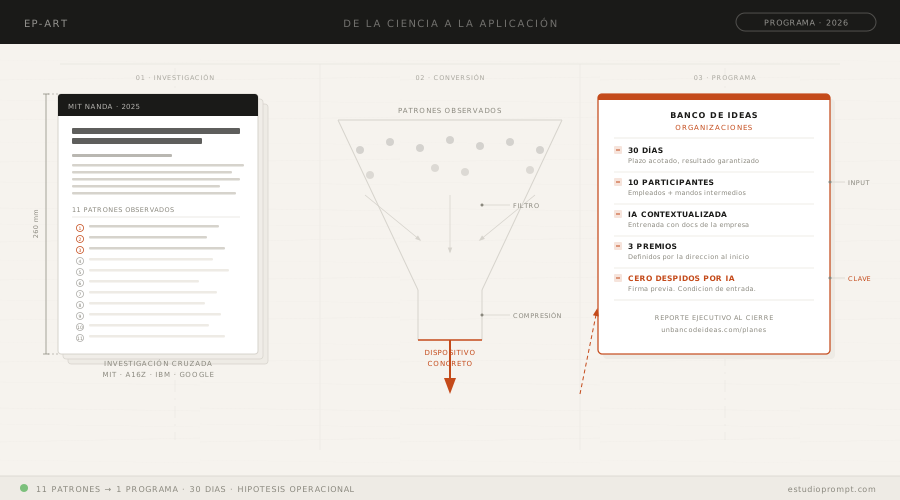
There is research on why AI projects in companies fail or succeed. The ones that work share a set of conditions that repeat with remarkable consistency. This program takes those patterns — observable, documented — and assembles them into a concrete device, designed to reproduce them deliberately in organizations that don’t generate them on their own.
Versión en español: De la ciencia a la aplicación ↗
The origin
A few weeks ago this blog published an article titled Organizations riding the Artificial Intelligence wave ↗. Its starting point was an uncomfortable fact: AI adoption is massive, but value is rare. According to McKinsey (a survey of nearly 2,000 organizations across 105 countries), 88% already use AI in at least one function, but only 39% report any impact on results — and barely ~6% capture significant value. The MIT study of 300 real deployments — the most cited, and also the most disputed — points in the same direction: the vast majority of pilots stall, with no observable impact on the P&L. And BCG, measuring adoption in the workplace, found the silent variable: employees’ fear of losing their jobs.
Only 5 or 6 out of 100 succeed. The article calls that minority, as a shorthand, “the 5%”.
The article didn’t stop at the diagnosis. It cross-referenced the data from McKinsey, BCG and MIT with Andreessen Horowitz, Deloitte, Google Cloud, IBM, Microsoft and London Business School, and extracted a list of eleven repeated patterns in the organizations that were actually producing value. Not hypotheses: observable characteristics. Ideas emerged from below. Tools were bought instead of built. Invisible processes were targeted instead of visible ones. Execution happened on short timelines. The AI had organizational context. Middle managers participated. And above all, there was a silent but decisive condition: employees felt secure about their jobs.
(The methodological criticisms of the MIT report — which exist and are reasonable — are covered in detail in that article ↗: the conclusion doesn’t depend on that single source, and the McKinsey + BCG + MIT tripod says the same thing from three different methodologies.)
The article’s conclusion was that the difference between the 5% and the 95% does not appear to be fundamentally technical. The tools are the same. The models are the same. The budgets are often comparable. What changes is the direction of flow and the conditions of trust. McKinsey confirms it from its own sample: what most distinguishes the high performers is the intentional redesign of workflows — almost 3 times more likely than in the rest.
That left an open question.
The hypothesis
If the patterns of the 5% are observable and replicable, it should be possible to design a concrete device that reproduces them deliberately in a real organization, without waiting for its culture to generate them spontaneously — something most companies never achieve.
Find patterns, use them to predict tokens. Find patterns, use them to predict outcomes.
In other words: if we know what successful companies do differently, we should be able to manufacture a short, bounded, well-designed environment that activates those same patterns in companies that don’t start from that culture.
The hypothesis can be stated like this:
A program combining the eleven identified patterns — in a single format, on a short timeline, with explicit commitments from management — should improve the odds of systematically moving an organization from the majority that adopts without capturing value to the minority that does.
This is the idea. What follows is, first, the shape that device ended up taking, and then why each of its components is justified by one of the observed patterns.
The idea: a 30-day internal micro-contest
The resulting format is called Banco de Ideas Organizaciones (Idea Bank for Organizations). In its simplest form:
A company selects up to 10 participants — employees from different levels, including middle managers. For 30 days, those participants access a private platform where they propose, debate and vote on ideas for applying AI to concrete processes in their own company. They are accompanied by an AI trained on the organization’s internal documentation: process descriptions, goals, improvement areas. Management defines up to three prizes, visible from the start of the cycle. And it signs, before starting, a public commitment of zero layoffs caused by AI: if a function is automated, the organization commits to reassigning the worker or expanding their role.
At the close of the 30 days, the organization receives an executive report with all the proposals, the three winners and implementation recommendations — including which workflow to redesign first, not just which tool to try. It is the direct translation of McKinsey’s finding: high performers don’t accumulate tools, they redesign how the work gets done.
That’s it. Platform, timeline, signed commitment, AI with context, prizes, peer debate, final report.
Seen in the abstract it might look like a reasonable but arbitrary collection of elements. It is not. Each component is there because it corresponds to one of the patterns observed in the 5%. What follows is that correspondence.
The justification, pattern by pattern
Pattern 1 — The idea is born where the problem lives, not where the budget lives
The pattern. Successful projects share a characteristic that rarely appears in strategic plans: the solutions were proposed by employees. They emerged from the people who run the processes and know where it hurts.
The component. The micro-contest deliberately inverts the direction of flow. Management doesn’t propose solutions; it provides the space. Employees detect, formulate and propose. The system’s question is not “what would you like management to do?” but “which task in your daily work do you think AI could improve?”.
“Leadership sees inefficiencies in aggregate; employees experience them in detail.” — Xponent21, Rethinking AI Adoption
Pattern 2 — Buying what exists works better than building it at home
The pattern. Buying tools from specialized companies succeeds in around 67% of cases. Building internally succeeds only a third as often.
The component. The program doesn’t require the organization to build anything technical. The platform is built. The AI is connected. The propose-debate-vote flow is tested. The only thing the organization contributes is what only the organization has: context, people, judgment about which prizes motivate its team.
Pattern 3 — AI where nobody sees it pays more than AI in the spotlight
The pattern. More than half of generative AI budgets go to sales and marketing. The highest ROI, however, sits in back-office automation: processing invoices, classifying emails, organizing data, reconciling reports.
The component. The system explicitly invites people to look at the unglamorous. The AI, trained on internal documentation, knows the administrative and operational processes and steers questions there. The prompt is not “propose a brilliant idea”; it is “identify a task in your week that eats your time and nobody sees”.
Pattern 4 — Solving a concrete problem beats “transforming the organization”
The pattern. Projects that work target a specific, measurable, recent pain. Projects that fail begin with phrases like “transforming the organization”.
The component. The micro-contest format forces things down to earth. There is no room for strategic presentations. The participant proposes a concrete idea, applicable to an identifiable process, with an imaginable result. Peer debate and voting filter out the abstract. What survives the 30 days is, by construction, actionable.
Pattern 5 — An AI that knows your company outperforms a generic AI by far
The pattern. ChatGPT and its peers work extraordinarily well for individuals, but stall in enterprise settings because they don’t adapt to how each organization works.
The component. Every document management uploads builds a private knowledge base exclusive to that company. The AI accompanying employees through the cycle is not generic: it knows the business, the language, the specific frictions. It’s the difference between asking a consultant who just arrived and one who’s been in the house for years.
Pattern 6 — If it takes too long to go from pilot to real use, it dies along the way
The pattern. Mid-sized companies go from pilot to real use in about 90 days. Large enterprises take 9 months or more. The longer the crossing, the more likely the death by reorganization or by losing the executive who championed it.
The component. 30 days. The timeline is not arbitrary: it respects the pattern of the companies fastest at moving from pilot to real use, and leaves a margin for the executive backing the program to still be there when the results arrive.
Pattern 7 — The AI your employees use in secret is not a risk, it’s a map
The pattern. 80% of workers use AI at work, but only 22% do so exclusively with official tools. Every “under the radar” use is a project proposal in disguise.
The component. During the 30 days, the program opens an explicit, sanction-free channel for employees to declare which tools they’re already using, for which tasks and with what results. Prior use is not penalized: it is mapped. What surfaces is, in many cases, the best available evidence of where AI adds real value in that specific organization.
Pattern 8 — Middle managers decide whether AI really gets in or not
The pattern. Employees learn to use tools by watching their direct bosses. If the middle manager doesn’t understand AI, doesn’t prioritize it or doesn’t use it, no central program will compensate for that absence.
The component. The program allows — and recommends — including middle managers among the cycle’s participants. Not as observers or evaluators: as full participants, with the same rules and the same prizes. When the direct boss proposes, debates and votes alongside the team, AI stops being the CEO’s project and starts being part of the area’s everyday language.
Pattern 9 — Expecting results in six months kills the project before it can breathe
The pattern. Only 6% of AI implementations achieve returns in under a year. Most take between 2 and 4 years.
The component. The program redefines what gets measured at 30 days and what gets measured at 12 months. At 30 days: participation rate, number and quality of proposals, ideas selected for implementation. At 12 months: operational impact of the proposals that were actually implemented. Separating the two horizons avoids the classic mistake of demanding ROI from a device whose immediate function is to generate the inventory of opportunities, not to produce the savings.
Pattern 10 — Knowing how to use AI matters more than having the best AI
The pattern. The gap between the 5% and the rest is, to a large extent, a learning gap. Not a model gap.
The component. During the micro-contest, each participant interacts with the AI in the real context of their work. Not in an abstract prompting course. The organizational capacity to understand what these models can and cannot do grows as a byproduct of the cycle itself: at the end of the 30 days, there aren’t just proposals; there’s a team with hands-on experience.
“It’s not the quality of the AI models, but the learning gap for both tools and organizations.” — Aditya Challapally, lead author of the MIT NANDA report
Pattern 11 — Without job security, nobody proposes how to automate their own work
The pattern. Employees who fear losing their jobs to AI do not propose how to apply AI to their own work. Without an explicit guarantee, participation becomes performative: employees contribute safe ideas, not valuable ones.
The component. The program requires management to sign, before the cycle begins, a public commitment of zero layoffs caused by AI. If a function is automated, the organization commits to reassigning the worker or expanding their role. It is not a decorative statement: it is the condition of entry to the program.
This is, probably, the most important component of all. Not out of kindness. Out of incentive engineering. Without that signed, communicated commitment, what you collect over 30 days are decorative ideas. With it, you unlock the inventory that would otherwise never appear.
The convergence
The eleven components don’t work separately. They work because they are designed to reinforce each other.
The no-layoffs commitment (pattern 11) enables the valuable proposals. The AI with context (pattern 5) raises their quality. The short timeline (pattern 6) protects them from death by delay. The focus on the invisible (pattern 3) points them at where the real return is. Including middle managers (pattern 8) ensures the approved ones actually get executed. The shadow AI amnesty (pattern 7) adds to the inventory what is already validated by use. And it all happens in 30 days, in a device bought rather than built (pattern 2), centered on concrete problems (pattern 4), proposed from below (pattern 1), measured on two distinct horizons (pattern 9), generating organizational learning as a byproduct (pattern 10).
It is not a collection of best practices. It is a system designed so that each piece compensates for the weaknesses of the others.
What remains to be validated
The program, like any operational hypothesis, requires empirical validation. The variables to measure in each cycle are the same ones identified at the end of the previous article:
- Does the signed no-layoffs commitment actually change the quality and depth of proposed ideas? Comparable through cycles with and without an explicit commitment.
- Does contextualized AI produce materially better proposals than AI without context? Measurable with a double group and blind evaluation.
- Do visible prizes increase participation or bias toward conservative ideas? Detectable by comparing cycles with and without prizes.
- Are 30 days enough, or do deeper ideas need a longer run? Comparable with 30, 60 and 90-day cycles.
- Does deliberately including middle managers change the downstream implementation rate? Measurable by crossing group composition with 6- and 12-month follow-up.
Every pilot of the program is, in this sense, also an experiment. The data it produces feeds the redesign of the next cycle.
Setting the methodology aside
It is possible that success with AI depends less on the sophistication of the technology and more on the organization’s capacity to capture, validate and scale the ideas its own employees already have and, often, are already executing in silence.
The 5% doesn’t do something radically different. It does something radically closer to where the work happens.
Most organizations don’t have a space where that closeness can show up. They have suggestion boxes nobody checks, brainstorming meetings where only the usual voice speaks, innovation platforms with awkward interfaces and opaque evaluation processes. Collective intelligence exists, but it can’t find anywhere to show up.
Building that space — small, bounded, safe and well designed — is possibly the most important work an organization can do regarding AI. Not buying a flashier tool. Not hiring another consultancy. Not launching a program with a catchy name.
Creating a place where the people who know the work can propose how to improve it. And where, in doing so, they don’t feel exposed, evaluated or threatened, but heard.
That is what the program tries to produce: not as spontaneous culture — which most companies never achieve — but as a deliberate device.
As of today, it is not a guarantee. It is, probably, the best reasonable bet available for an organization that wants to stop being part of the majority that adopts AI without capturing value, without having to wait for its culture to change on its own.
See the program
The device described in this article is available as a pilot under the name Banco de Ideas Organizaciones. 30 days, up to 10 participants, up to 3 prizes, AI trained on the company’s documentation, final executive report, and the “Zero layoffs caused by AI” seal signed by management as the condition of entry.
Banco de Ideas — Program for organizations ↗
References
- Lafferranderie, D. (2026). Organizations riding the Artificial Intelligence wave. Estudioprompt. estudioprompt.com ↗
- McKinsey & Company. (2025). The State of AI: Global survey (n≈1,993 organizations, 105 countries). mckinsey.com ↗
- BCG. (2025). AI at Work 2025: Momentum Builds, but Gaps Remain. bcg.com ↗
- MIT NANDA. (2025). The GenAI Divide: State of AI in Business 2025. nanda.media.mit.edu ↗
- Estrada, S. (2025). MIT report: 95% of generative AI pilots at companies are failing. Fortune. fortune.com ↗
- Xponent21. (2026). Rethinking AI Adoption: The Bottom-Up Method Modern Leaders Need. xponent21.com ↗
- UC Berkeley Professional Education. (2025). Beyond ROI: Are We Using the Wrong Metric in Measuring AI Success? exec-ed.berkeley.edu ↗
- Google Cloud. (2025). The ROI of AI: Agents are delivering for business now. cloud.google.com ↗
- IBM. (2026). Is rising AI adoption creating shadow AI risks? ibm.com ↗
- TechClass. (2026). Why Middle Managers Drive AI Transformation Success. techclass.com ↗
- Master of Code. (2026). AI ROI: Why Only 5% of Enterprises See Real Returns in 2026. masterofcode.com ↗
- London Business School. Employee-led innovation. london.edu ↗